Showing posts with label Essay. Show all posts

Tuesday, October 21, 2014

Week 10 Essay: Eskimos: Single Men, Wizards, and Paranormal

This week there were many reoccurring motifs in the unit Eskimo Folk Tales.  These motifs included unmarried men (in the beginning of just about every tale), shamans, and in some cases the undead or ghosts.  When going through the unit, one can see that all of the stories are single paged and not very long. They get straight to whatever point they are trying to make then it abruptly ends.  At first this kind of annoyed me while reading, but I had to remind myself that the tales were derived from oral stories.  I believe that since these stories stay as true to oral traditions as they can, explains the reoccurring themes.

Of the many stories that began with a man he was always unmarried and either a good or bad hunter.  Whether he could hunt was an important aspect to the Eskimos for they thrived on the animals they hunted.  Many times these men would have many brothers that either took care of him or competed him when it came to how much game they were able to obtain.  This was effective for Eskimo storytellers since this gave the audience a homely perspective when listening to this story around a fire.

Wizards, magic men, or shamans were prevalent in this unit as well.  They were mentioned many times in the text, but they were by far more prevalent in the images before the stories.  Many times you almost miss the images.  There were many that did no seem to pertain to the actual stories, and were just pieces of art the author presented.  I look at the wizards and shaman as their sort of religious belief system.  Majority of the time villagers went to the wizards for help and advice.  The wizards would consult on the "spirits" a lot of the time in order to know what to do.

 Source
                      Source          Wizards preparing for a "spirit fight."     I have no clue what this is.


Lastly, I feel like in todays society and culture we fear death (at least here in the US).  The Eskimo's, at least of this time, do not seem to have this belief system.  As explained in their creation story, The Coming of Men, A Long, Long While Ago, the first people created actually accepted the new concept of death in order to be privileged with light.  They believe that if one dies with a grudge on their heart that they were able to come back as a ghost and attack their enemies.  Much to my surprise there was a story where a man was able to bring back a zombie to attack one of his brothers.  I just feel like this unit was about more than just the stories themselves, they gave insight on how the Eskimo's routines and cultural beliefs.

Friday, October 3, 2014

Week 7 Essay: Spelling Rules


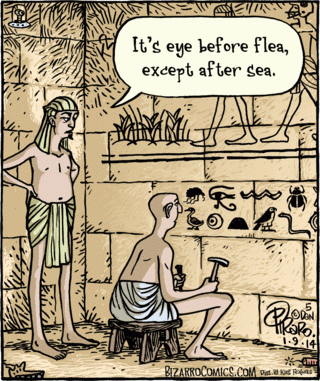
For this week's essay assignment, I decided to write over English spelling and it's many rules.  In the cartoon below there is a rule that many of us have become familiar with as we learned to spell in grade school.  I can say, for myself, that I use this rule often whenever the vowels "e" and "i" must be put together. When reviewing the article related to this assignment I did not realize that the rule "i before e, Expect after C" also has another two lines to it that will expand on this writing skill (which is noted below).


The following rhymes contain the substance of the last three rules : —
i before e,
Except after c,
Or when sounded as "a,"
As in neighbour and weigh.
(Wikipedia)
I like this cartoon, and find it funny, because that it symbolizes how long the rule has been used.  Since not all languages use our alphabet, the way the rule is used in this cartoon also gives it a comical twist.  Egyptians obviously used hieroglyphs for reading and writing processes.  Since hieroglyphs were symbols representing entire words, or ideas, this rule would not have been applicable to them since it only applies to the English alphabet. 

When trying to look back, this is the only spelling rule that comes to the front of my mind.  I decided to Google search the most common spelling rules, which we use daily, and may not realize.  My first search revealed a website which contains information regarding the top four spelling rules.  The first rule, funny enough, is the rule that is regarded in the cartoon.  The next rule is over dropping the final "e" before a suffix that begins with a vowel, but not before a suffix that starts with a consonant.  For example: ride+ing= riding or like+ness= likeness.  The third talks about converting a word that ends in "y," and changing this to an "i" before a suffix, unless the suffix itself begins with an "i" already.  Examples include: defy+ance= defiance or occupy+ing = occupying.  The fourth, and final, rule is probably one that I find the most difficult at times.  This rule is about doubling final consonants in words.   There are two parts of this rule, "(a) a single vowel precedes the consonant; (b) the consonant ends an accented syllable or a one-syllable word." Examples are as follow:  stop+ing= stopping or benefit+ed= benefited.  

As I was researching for this essay, I began to realize just how complex the English language really is.  I can see why if one was not brought up speaking, and more particularly writing, in English then it can be extremely difficult to learn.  Above I have listed four basic rules regarding English spelling, but it seems that there are exceptions to every rule which just adds to the complexity.  

If you are more interested on the spelling rule that is depicted in the picture, and was introduced first in this essay, you can enlighten yourself here.
For information regarding the website that contained information over the three other rules mentioned, the link for the website can be found here

Friday, September 26, 2014

Week 6 Essay: Motif and Reoccurring Themes


For this weeks Un-Textbook assignment, I decided to read the Unit: Filipino Popular Tales.  These stories were derived, by the author, from tales derived from many regions of the Philippines.  As I began to read the stories there were some reoccurring themes, and motifs, that I began to recognize a trend.  Many of the stories that contained animals normally had a jealous character, or a trickster among the characters. Normally, the one who is playing the tricks was either a monkey or a turtle.  Many of the stories where a trickster was involved, the poor victim were more times than not hurt very badly or killed.  One phrase that I had read many times was that the animals would ask their victim if they wanted to wear "the King's belt," which turned out to be an anaconda, and when they would accept they would either be killed or nearly strangled to death.  

(The King's belt, Wikipedia)

When the stories consisted of humans there was usually a man who was either interacting with his father, and family, or he was told by someone that he would marry a princess.  Two particular stories contained plots where two poor men were fortunate enough to marry a princess despite odds. One man was aided by a devil, which I found VERY strange that people were interacting with devils, and in the other story God helps a man who he think is a noble being. Although one story focuses on a good entity, and the other a bad one, they both show a spiritual side of Filipinos and how important this aspect was to their culture.  A last theme that I would like to mention is how many stories, towards the end of the unit, would either describe either a moral or why something in nature occurs the way it does.  My favorite of these two motifs was how animals have come to behave as we know them to.  For instance there were explanations to why chickens peck the ground, why squids carry black ink, why the Coling has a bald spot, etc.  Today, we all know that there is a scientific explanation for why all these things occur, but I enjoy hearing these "creation-like" stories and enjoy their imputes. 

(A Coling, Wikipedia)

Thursday, September 18, 2014

Week 5 Essay: Genies, Magicians, and Enchantresses, Oh My!

For this week's Essay, I have decided to write over the reoccurring magic theme in my Un-Textbook Unit: Arabian Nights. It appeared in many forms such as genies, magicians, enchantresses (a female magician of sorts), and even in the story telling itself.  The story begins with Scheherazade fighting, in a sense, to save her own life but also to end the string of women's deaths at the order of the Sultan.  Each of her stories are so intriguing that the Sultan (and readers) get caught up in the plots and they do not realize that she has successfully ran one story into completely new one or even two.  The author himself did this very well, for I had completed this reading faster than any other weeks.  In this Unit the genies performed the most magic.  Majority of the time they were doing it at the will of those who beheld their lamps or rings, but in one instance a genie showed rebellion and was about to use his power to attack the fisherman who set him free.  Also in one of the stories, a genie was about to kill a man who had "killed his son."  This was surprising because the origin of the genie was not relieved, and there was no "master" present and controlling him.  This Unit opened up questions to whether there were different types of genies.  It made me wonder where they came from, and how some bound to an object and other's weren't.  Magic was most definitely a dominant element in this week's readings for it gave a surreal and extradorinary feel to the stories.  The last half of the Unit was about Aladdin and his genies, and if they were not present there isn't much of a plot left.  Yes, of course, genies are not real but Scheherazade's narration was magnificent enough to make them seem real in her stories.  

(One of the many genies present in the stories, Heritage History)

Tuesday, September 9, 2014

Week 4 Essay: Analysis of the God's and Goddess's of Ancient Egypt

  For this week's reading it was somewhat difficult to decipher the gods and goddesses expect for maybe a small handful. For reference the Unit: Ancient Egyptian Myths and Stories can be found here. The stories never really went into full detail other than mentioning their purpose and roll in handling, or governing, society.  Great emphasis went into Ra, and he was present at some point in almost every story.  Nu, Ra's father, always had a sense of divine wisdom to him and he never seems to lose his temper. He was never hot-headed and was always there when Ra needed his council.  Isis wasn't necessarily a bad goddess, but she did use treacherous ways to achieve the title of deity.  If it weren't for her drive and being an enchantress she would have remained just another human.  
  Throughout the tales Osiris seemed to be the most good-natured god, and he interacted with the humans the best.  He banded the different tribes together, unified them, and created the law and order of the land.  He brought peace and tranquility to the kingdom, and it was trouble-free at one point to where he felt he could temporarily leave his kingdom and spread peace elsewhere.  When he died sorrow came over his followers, and it sent Isis into a frenzy.  Ra was regarded as the first actual ruler of mankind, but when he grew in age and left them they did not possess a good foundation or unity.  Man lived as they pleased, and their little bands battled amongst each other.  Another character the author chose to emphasize on was Set, Orsis's brother, who acquired a different temperament than Orsis.  He was the modern day bad guy who had it out for his brother's crown.  He sabotaged Orsis's homecoming, killed his brother, and banished Isis as she traveled to find his remains.  
  One thing that I notices was when there were times when a certain individual or god was in need of help, the only time they would receive it was when the situation was direly desperate.  After completing two weeks of readings on Greek Mythology I can see a vast diversity in comparison.  In Greek Mythology the god's helped those in need far more than the Egyptian's did.  The reason why was not discussed in the Unit, but it did leave a lot up to speculation and inference.  I don't know if this Unit cuts out a lot of information for the sake of length and reading time, but I have concluded myself that it seems that Egyptian Mythology is rudimentary when compared to Roman or Greek Mythologies.  


Friday, September 5, 2014

Week 3 Essay: Ease of Reading

I found this assignment under the Essay topics, and it discusses how visual ques aid us when reading. There were many passages, and below I will discuss the one that was the most challenging for me to decipher.  

For me, it was more difficult to read passages that contained all upper case letters and lacked spaces in between the words.  For example: 
 Example 6
AMANHADSIXCHILDRENANDWASVERYPROUDOFHISACH
IEVEMENTHEWASSOPROUDOFHIMSELFTHATHESTARTE
DCALLINGHISWIFEMOTHEROFSIXINSPITEOFHEROBJ
ECTIONSONENIGHTTHEYWENTTOAPARTYHEDECIDEDT
HATITWASTIMETOGOHOMEANDWANTEDTOFINDOUTIFH
ISWIFEWASREADYTOLEAVEASWELLHESHOUTEDATTHE
TOPOFHISVOICESHALLWEGOHOMEMOTHEROFSIXHISW
IFEIRRITATEDBYHERHUSBANDSLACKOFDISCRETION
SHOUTEDBACKANYTIMEYOUREREADYFATHEROFFOUR

I found that although punctuation is a valuable tool, the lack of spacing made readings all the more difficult.  If an example contained writing that followed non-standard use of upper- and lower-case letters, but had at least some variation then the reading became easier. Reading out loud, reading slowly, and even placing my finger on the screen were tactics I had to utilize to make reading easier.  I think the development of spaces in sentence structure was derived so that we, as human beings, could understand the flow of text better.  Without the spaces it is easy for one to become impatient with the reading, and skipping over words can occur.  When reading the passage about, I had to read it several times or I found myself skimming, getting the main point of the text, but missing key details. By doing this I was only getting part of what was being told in the joke, and I was beginning to become confused on what was going on. Punctuation is also important that it ends and separates one idea from another. If punctuation was absent in a writing run-ons would occur, and ideas become interconnected.  When this happens the reader, again, becomes confused.  During this assignment if the readings at least had either punctuation or use of both upper- and lower-case letters the reading was easier. I find this is because they are cues to separate individual words and ideas.  This way when someone reads the text they have an understanding of what is going on.  


Thursday, August 28, 2014

Week 2 Essay: Tragedy In Ancient Mythology


In this week's reading there was a trend of many tragic endings.  Some stories in particular include: Daedalus and Icarus, The Death of HerculesOrpheus and Eurydice, and The Death of Adonis.  Each ending consists of an unforeseen death, or death has already been integrated in the plot.  Out of all of these stories Orpheus and Eurydice was the one I found the most disheartening.  Specific elements of the story are matrimony, loss, and re-loss. Orpheus loses his wife on his wedding day when a serpent fatally bites Eurydice’s ankle.  He was a famous Greek musician, and he travels to the underworld to retrieve her.  While there he performs a song so touching, it persuaded Pluto and Persephone.  He was granted his wife, but was instructed not to look back at her until they have returned to the mortal world. On their journey back, Orpheus begins to wonder if his wife is still beside him and tries to sneak a look at her.  In the instant he turns his head, she disappears in thin air, and he is forbidden to cross the river of Styx again. This last scene received the saddest emotional response from me. One could sense that the young man was in love with his wife, so much that due to human error he lost her a second time.  

 
(Modification of Orphée ramenant Eurydice des enfers 1816
 by Jean-Baptiste-Caille Corot (1796-1875: Wiki Commons)

In each of the other readings each person's death is secondary to ignorance, or an incurable mistake in Hercules’ case. Orpheus and Eurydice were on the verge of their happily ever after, when a single snake happened to be in the right place at the right time.  I view this as misfortune, and there wasn’t anything the newlyweds could do to prevent the bite. In the other stories I feel that death was used as a lesson learned, or a transformation to a bigger plot.  Icarus and Adonis were both warned by loved ones to take care in choosing their actions, and instead of taking precaution they evidentially ended themselves with ignorant tragedy.  In the case of Hercules his death was just another epic feat of his, and in the end he was able to enter Mount Olympus and become a god.  In his story his death could initially viewed as a tragedy, but then emotions could change since he is obtaining a higher status such as immortality.